
user-acceptance-testing
What is User Acceptance Testing?
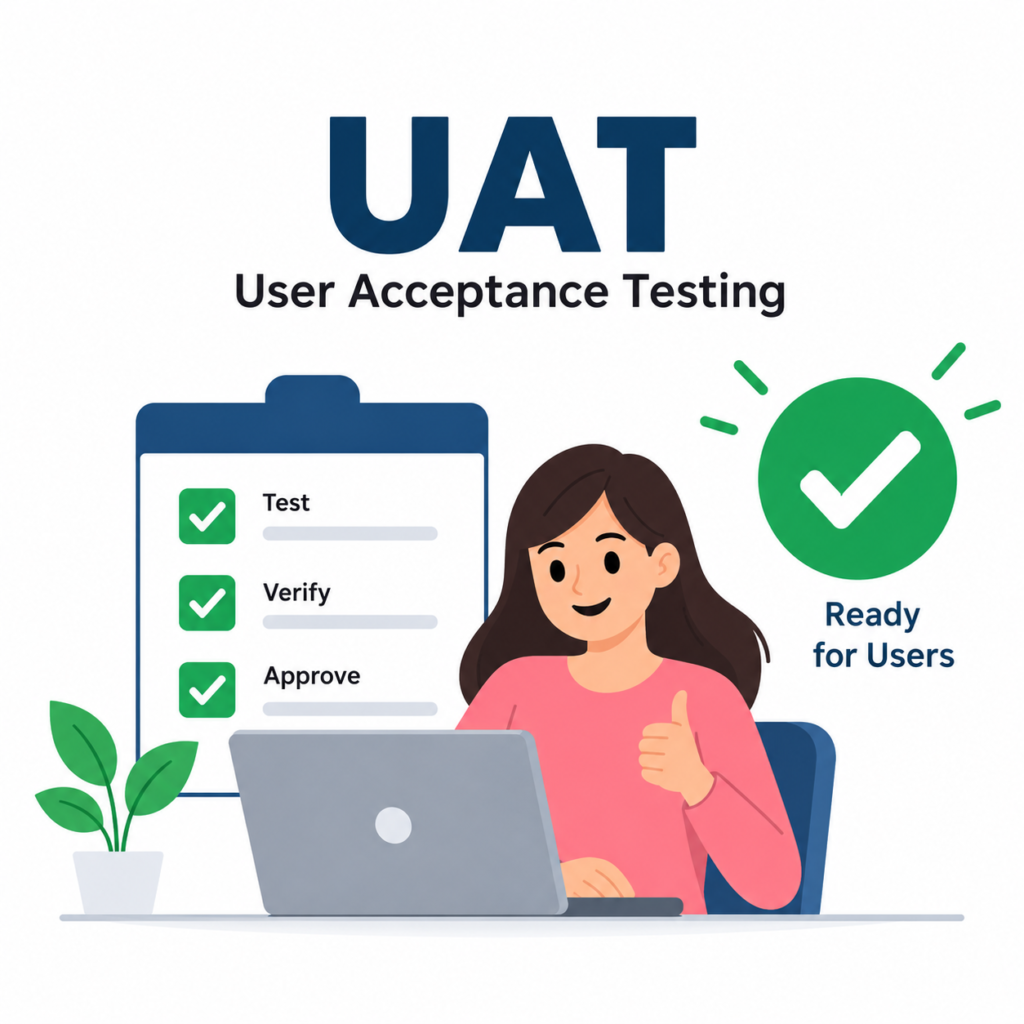
User Acceptance Testing (UAT) is the testing performed to check whether the application meets real user needs and business requirements before it is released for actual use.
“UAT checks whether the application is actually ready for the customer or end user to use.”
The main focus is not only whether the software works technically, but whether it works the way the business and users expect it to work.
User Acceptance Testing (UAT) – Types
- Business Acceptance Testing (BAT) – Checks whether business requirements are fulfilled.
- Contract Acceptance Testing – Verifies that the software meets agreed contract requirements.
- Alpha Testing – Internal testing before the product reaches external users.
- Beta Testing – Selected real users test the product before final release.
- Operational Acceptance Testing (OAT) – Checks whether the application is ready for real-world operation.
- Regulatory Acceptance Testing – Verifies compliance with required laws and regulations.
- Compliance Acceptance Testing – Checks whether the application follows required standards and organizational rules.
- Production Acceptance Testing – Performs final checks in a production-like environment before or during release.
User Acceptance Testing (UAT) – Interview Questions & Answers
1. What is User Acceptance Testing?
Answer:
UAT is testing performed to check whether the application meets business requirements and real user expectations before release.
2. What is the main purpose of UAT?
Answer:
The main purpose is to confirm that the application is ready for real-world business use.
3. Who performs UAT?
Answer:
Usually business users, customers, Product Owners, SMEs, or selected end users perform UAT.
4. When is UAT performed?
Answer:
UAT is generally performed after QA/System Testing and before the application is released to production.
5. What is the difference between UAT and System Testing?
Answer:
System Testing checks whether the complete system works correctly, while UAT checks whether it meets business and user needs.
6. What is Acceptance Criteria?
Answer:
Acceptance Criteria are the conditions that must be satisfied for a feature to be considered acceptable.
7. What is a UAT test scenario?
Answer:
It is a real business or user activity that needs to be verified.
Example: Customer should be able to successfully place an order.
8. Give a real-time example of UAT.
Answer:
In an e-commerce application, a business user checks Login → Search Product → Cart → Checkout → Payment → Order Confirmation.
9. What happens if UAT fails?
Answer:
The issue is reported, developers fix it, and the scenario is tested again.
10. What is UAT Sign-off?
Answer:
UAT Sign-off is formal approval from the business/user side that the application meets the agreed requirements and is ready for release.
11. Is UAT manual or automated?
Answer:
UAT is mainly manual and user-driven, although some scenarios can be automated.
12. Can QA testers perform UAT?
Answer:
QA can support UAT, but final acceptance is generally provided by business or user representatives.
13. What are the common types of UAT?
Answer:
Common types include Business Acceptance, Contract Acceptance, Alpha, Beta, Operational Acceptance, and Regulatory Acceptance Testing.
14. What is the difference between UAT and Functional Testing?
Answer:
Functional Testing checks whether a feature works correctly. UAT checks whether the feature satisfies the actual business requirement.
15. What is the role of QA in UAT?
Answer:
QA can prepare test data, scenarios, environment, documentation, and help business users execute and track UAT.
16. Where is UAT performed?
Answer:
UAT is normally performed in a dedicated UAT or staging environment that is close to the production environment.
17. What makes a good UAT scenario?
Answer:
It should represent a real business activity, have a clear expected result, and be connected to a business requirement.
18. Can UAT replace System Testing?
Answer:
No. System Testing and UAT have different purposes. UAT focuses mainly on business and user acceptance.
19. What is the biggest benefit of UAT?
Answer:
It gives the business confidence that the application is ready for real users.
20. Explain UAT in one sentence.
Answer:
“UAT is the final business and user-level check to confirm that the application meets requirements and is ready for actual use.”