
Agile Model
What is the Agile Model?
Agile Model is a software development approach where the product is developed and delivered in small, manageable parts called iterations or Sprints.
Instead of building the entire application at once, the team develops a small feature, tests it, gets feedback, improves it, and then moves to the next feature.
Agile Model – Types
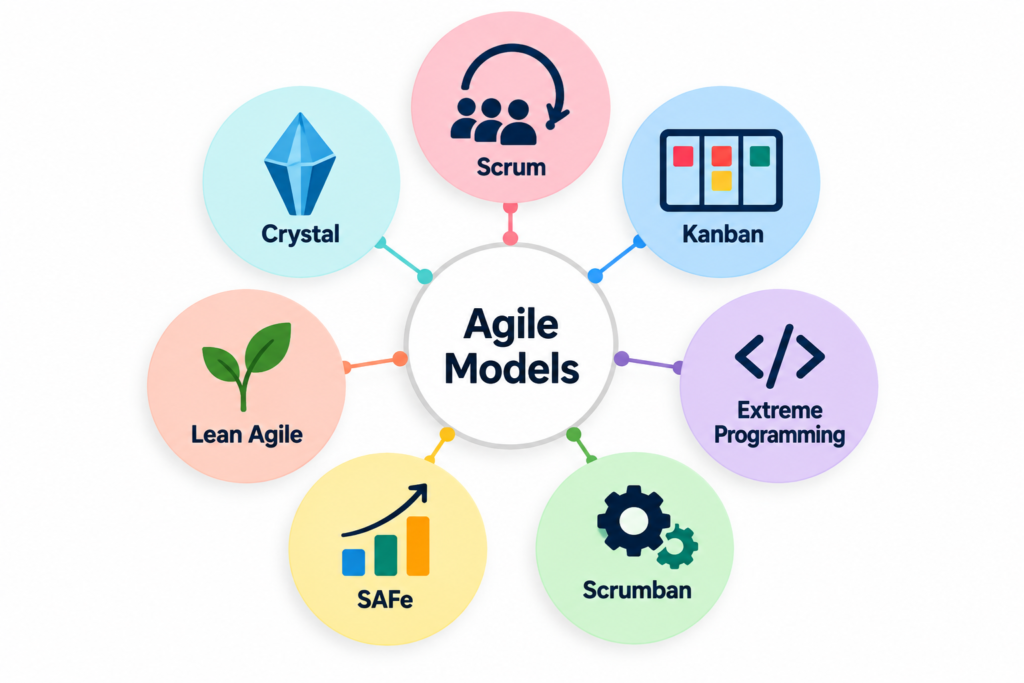
- Scrum – Work is divided into short Sprints with regular planning, review, and feedback.
- Kanban – Work is managed visually using a board like To Do → In Progress → Testing → Done.
- Extreme Programming (XP) – Focuses on coding quality, continuous testing, frequent releases, and customer feedback.
- Scrumban – Combines Scrum practices with the flexible workflow of Kanban.
- SAFe (Scaled Agile Framework) – Helps large organizations use Agile across multiple teams and projects.
- Lean Agile – Focuses on reducing waste, improving workflow, and delivering value faster.
- Crystal – Uses a flexible Agile approach based on the team size and project requirements.
Agile Model – Interview Questions & Answers
1. What is Agile?
Answer:
Agile is a flexible software development approach where the product is developed in small iterations or Sprints with continuous testing, feedback, and improvement.
2. What are the main Agile methodologies?
Answer:
The commonly known Agile methodologies are Scrum, Kanban, Extreme Programming (XP), Scrumban, SAFe, Lean Agile, and Crystal.
3. What is Scrum?
Answer:
Scrum is an Agile framework where the team works in short Sprints, usually with regular planning, daily meetings, reviews, and retrospectives.
4. What is Kanban?
Answer:
Kanban is a visual way of managing work. Tasks move through stages such as To Do → In Progress → Testing → Done.
5. What is Extreme Programming (XP)?
Answer:
XP is an Agile methodology that focuses strongly on code quality, continuous testing, frequent releases, and customer feedback.
6. What is Scrumban?
Answer:
Scrumban combines practices from Scrum and Kanban. It provides Scrum-style planning while using a flexible Kanban workflow.
7. What is SAFe?
Answer:
SAFe stands for Scaled Agile Framework. It helps large organizations apply Agile practices across multiple teams and projects.
8. What is a Sprint?
Answer:
A Sprint is a short development cycle in which the team works on selected requirements and delivers a working product increment.
9. What is a Product Backlog?
Answer:
A Product Backlog is a prioritized list of features, requirements, improvements, and other work that needs to be completed for the product.
10. What is a User Story?
Answer:
A User Story describes a requirement from the user’s point of view.
Example:
“As a customer, I want to log in so that I can access my account.”
11. What is the role of a Tester in Agile?
Answer:
A tester works throughout the Sprint. They understand requirements, create test cases, execute testing, report bugs, retest fixes, and perform regression testing.
12. What is the difference between Agile and Waterfall?
Answer:
Waterfall follows a sequential approach, while Agile works in small iterations and can adapt more easily to changing requirements.
13. When does testing happen in Agile?
Answer:
Testing happens continuously during the Sprint. Testers don’t wait until the entire application is completed.
14. What is a Sprint Review?
Answer:
In a Sprint Review, the team demonstrates the completed work to stakeholders and collects their feedback.
15. What is a Sprint Retrospective?
Answer:
The team discusses what went well, what problems they faced, and what they can improve in the next Sprint.
16. What is Daily Stand-up?
Answer:
It is a short daily meeting where team members discuss their previous work, today’s plan, and blockers.
17. What happens when requirements change in Agile?
Answer:
The change is discussed and prioritized with the Product Owner. It can be added to the backlog and planned for a suitable Sprint.
18. What is Regression Testing in Agile?
Answer:
Regression Testing checks that new changes or bug fixes have not broken existing functionality.
19. What are the advantages of Agile?
Answer:
Agile provides faster delivery, continuous feedback, regular testing, better collaboration, and flexibility to handle changing requirements.
20. What is the biggest advantage of Agile?
Answer:
The biggest advantage is flexibility. The team can respond to changing requirements and continuously improve the product based on feedback.