
Kanban
What is Kanban?
Kanban is an Agile way of managing and delivering work. It helps a team see what work needs to be done, what is currently being worked on, and what has been completed.
Kanban helps the team manage work visually and complete tasks smoothly without taking on too much work at once.
Kanban is commonly used in software development, testing, support, maintenance, and other types of work.
What is a Kanban Board?
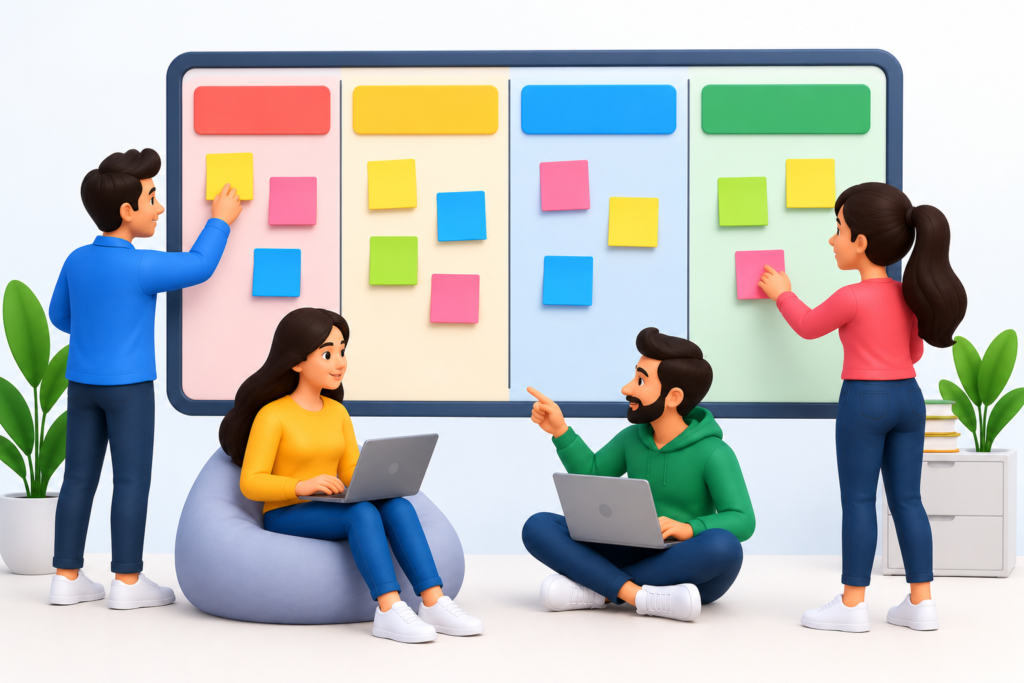
A Kanban Board is a visual board used to track work.
It can be a physical board with sticky notes or a digital board using tools such as Jira, Trello, Azure DevOps, or similar platforms.
Example
Imagine a team has these tasks:
- Login
- Registration
- Payment
- Search
What is WIP?
WIP means Work In Progress.
It refers to work that has started but is not yet completed.
For example:
Development WIP = 3
Testing WIP = 2
This means:
- 3 tasks are currently in development.
- 2 tasks are currently in testing.
The purpose of limiting WIP is to encourage the team to finish existing work before starting too much new work.
Kanban Interview Questions
1. What is Kanban?
Answer:
Kanban is an Agile way of managing work using a visual board. It helps teams visualize work, limit work in progress, and improve the flow of work.
2. What is a Kanban Board?
Answer:
A Kanban Board is a visual board that shows the status of work, such as To Do, In Progress, Testing, and Done.
3. What is WIP?
Answer:
WIP means Work In Progress. It represents work that has started but has not yet been completed.
4. What is a WIP Limit?
Answer:
A WIP Limit restricts how many items can be in a particular workflow stage at the same time.
5. Why are WIP limits important?
Answer:
They help the team avoid starting too much work at once and encourage finishing existing work.
6. What is a bottleneck in Kanban?
Answer:
A bottleneck is a stage where work starts accumulating because that stage cannot process the work fast enough.
7. What is Cycle Time?
Answer:
Cycle Time is the time taken from when work starts until it is completed.
8. What is Lead Time?
Answer:
Lead Time is the time from when work is requested until it is delivered.
9. Does Kanban have Sprints?
Answer:
No. Kanban does not require fixed-length Sprints. Work can flow continuously.
10. Does Kanban define specific roles?
Answer:
No. Kanban does not require specific roles. Teams can use the roles they already have.
11. What is the difference between Kanban and Scrum?
Answer:
Scrum organizes work into fixed Sprints, while Kanban focuses on continuous flow and limiting WIP.
12. How is Kanban useful for testers?
Answer:
Testers can use a Kanban board to track testing tasks, bugs, retesting, and completed work. It also makes testing bottlenecks easier to identify.
13. What happens when too many tasks are in Testing?
Answer:
The team should identify why Testing has become a bottleneck and work together to complete existing tasks instead of continuously starting new work.
14. Can priorities change in Kanban?
Answer:
Yes. Kanban is flexible, so teams can adjust priorities according to their workflow and business needs.
15. Can Kanban be used with automation testing?
Answer:
Yes. Automation tasks can be managed on the Kanban board along with manual testing, bug fixing, API testing, regression testing, and other work.