

Corrective Regression Testing
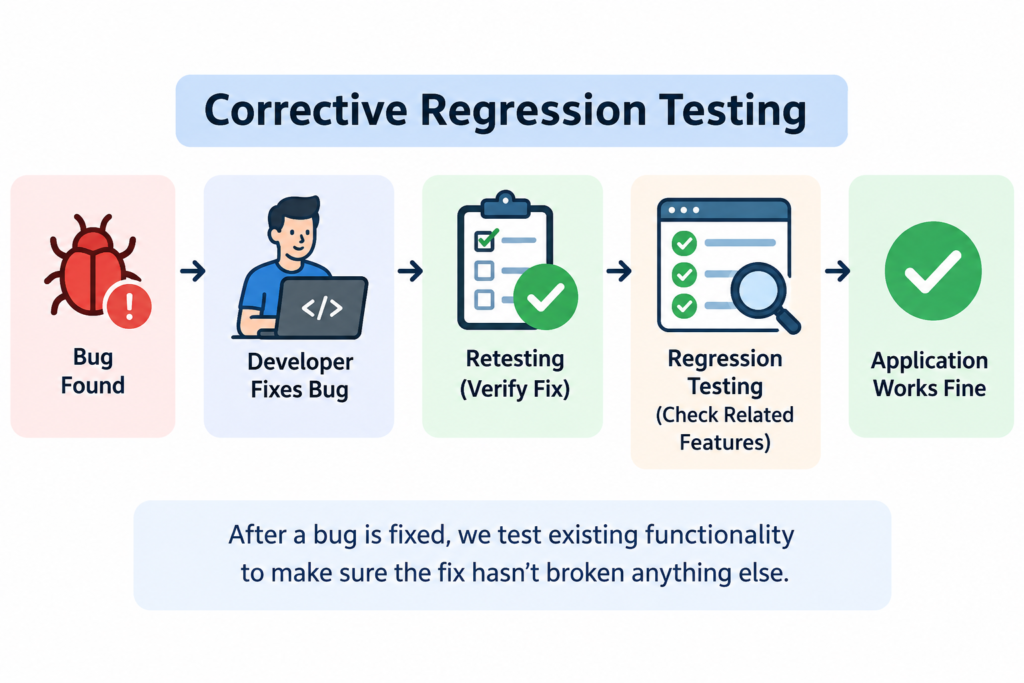
Corrective Regression Testing is performed when a bug is fixed or a small change is made in the application, and we test the existing functionality again to make sure the fix has not broken anything else.
Why Do We Perform Corrective Regression Testing?
- Make sure the bug is actually fixed
- Check that existing features still work
- Find side effects of the code change
- Reduce the chance of new bugs
- Maintain application stability
- Make sure old functionality is not broken
Corrective Regression Testing – Types
- Selective Regression Testing – Tests only the affected feature and related areas after a bug fix.
- Partial Regression Testing – Tests the changed module along with connected modules.
- Complete Regression Testing – Tests the entire application after major changes or important fixes.
- Manual Regression Testing – Testers manually execute regression test cases.
- Automated Regression Testing – Regression tests are executed automatically using tools like Selenium or Playwright.
Corrective Regression Testing – Interview Questions & Answers
1. What is Corrective Regression Testing?
Answer:
Corrective Regression Testing is performed after fixing a bug to make sure the fix has not affected any existing functionality.
2. Why do we perform Corrective Regression Testing?
Answer:
Because a small code change can sometimes create problems in other features. Regression testing helps us find those side effects.
3. What is the difference between Retesting and Regression Testing?
Answer:
Retesting checks whether the original bug is fixed.
Regression Testing checks whether the fix has broken anything else.
4. When do you perform Corrective Regression Testing?
Answer:
Usually after the developer fixes an existing defect and the tester successfully verifies the fix.
5. Give a real-time example of Corrective Regression Testing.
Answer:
Suppose a login bug is fixed. First, we verify that login works. Then we check related features like logout, forgot password, dashboard, and user profile.
6. What are the common approaches used in Corrective Regression Testing?
Answer:
Common approaches include Selective Regression, Partial Regression, and Complete Regression.
7. What is Selective Regression Testing?
Answer:
It means testing only the affected feature and related areas instead of running the complete regression suite.
8. What is Partial Regression Testing?
Answer:
It means testing the changed module along with the modules connected to it.
9. What is Complete Regression Testing?
Answer:
It means testing the complete application to make sure the changes have not affected any existing functionality.
10. Can Corrective Regression Testing be automated?
Answer:
Yes. Tools like Selenium, Playwright, and Cypress can be used to automate regression tests.
11. What test cases do you select for regression?
Answer:
We usually select test cases related to the changed code, affected modules, dependent features, and high-risk areas.
12. What happens if regression testing fails?
Answer:
We investigate the failure, report the defect if required, get it fixed, and then perform retesting and regression testing again.
13. Is Corrective Regression Testing manual or automated?
Answer:
It can be both manual and automated. Automation is useful when the same tests need to be executed frequently.
14. Can we perform Complete Regression after every bug fix?
Answer:
Technically yes, but it may not always be practical. For small fixes, selective or partial regression is often more efficient.
15. What is the main goal of Corrective Regression Testing?
Answer:
The main goal is to make sure the bug is fixed without breaking existing features.