
End-to-End Testing
What is End-to-End Testing?
End-to-End Testing (E2E Testing) is a testing method where we test the complete application flow from start to finish, just like a real user would use the application.
Instead of checking only one button, one API, or one feature, E2E testing checks whether different parts of the application work together correctly.
Why is End-to-End Testing Important?
Modern applications have many connected components.
For example:
- Frontend
- Backend
- APIs
- Database
- Payment system
- Authentication
- Third-party services
Each individual part may work correctly, but the complete application can still fail when these parts interact with each other.
E2E testing helps us verify that the whole system works together as expected.
Main benefits
- Finds real user-flow problems
- Checks complete business functionality
- Verifies different components work together
- Reduces manual repetitive testing
- Gives confidence before release
- Helps catch integration issues
- Improves overall application quality
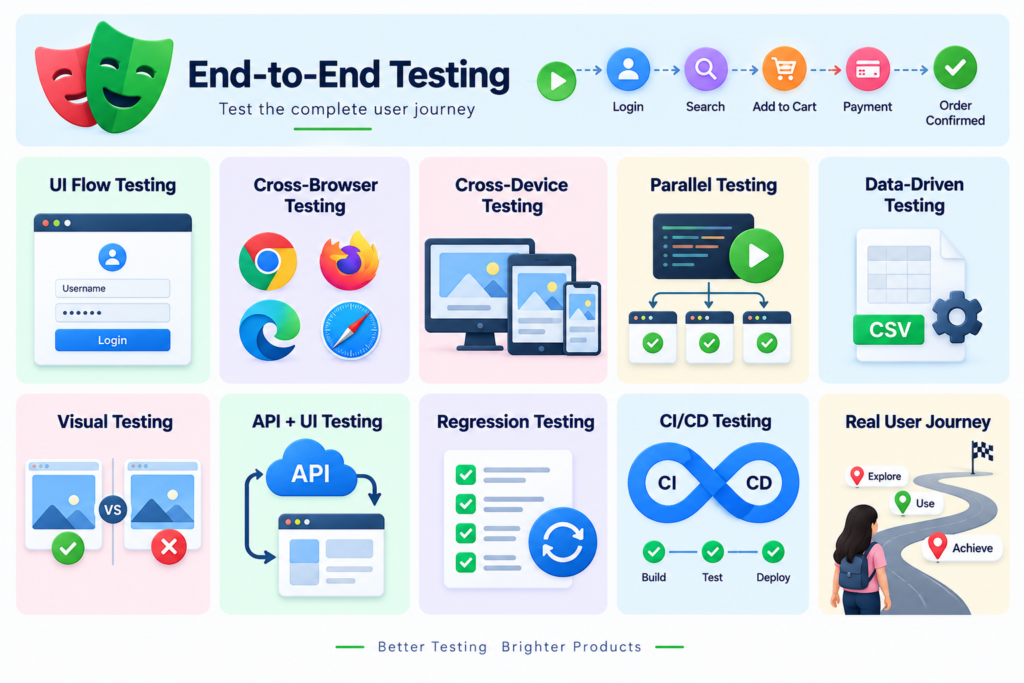
End-to-End Testing – Main Types
- UI Flow Testing — Tests complete user actions through the website UI.
- Cross-Browser Testing — Checks the same E2E flow on Chrome, Firefox, and Safari/WebKit.
- Cross-Device Testing — Tests user journeys on desktop, tablet, and mobile screens.
- Parallel Testing — Runs multiple E2E tests at the same time to save execution time.
- Data-Driven Testing — Runs the same test with different sets of test data.
- Visual Testing — Checks screenshots to find unwanted UI or design changes.
- API + UI Testing — Verifies that UI actions and backend APIs work correctly together.
- Regression Testing — Rechecks important existing flows after new changes.
- CI/CD Testing — Runs E2E tests automatically during the build and deployment process.
- Real User Journey Testing — Tests complete real-world flows like Login → Search → Cart → Payment → Order.
Interview Questions
1. What is End-to-End Testing?
End-to-End Testing verifies the complete application flow from beginning to end from the user’s perspective.
2. Why is E2E Testing important?
It helps verify that different application components work together correctly in a real user journey.
3. Give an example of E2E Testing.
Login → Search Product → Add to Cart → Checkout → Payment → Order Confirmation.
4. Which tools are used for E2E Testing?
Common tools include Playwright, Selenium, Cypress, and WebdriverIO.
5. What is the difference between Unit Testing and E2E Testing?
Unit testing checks small pieces of code, while E2E testing checks complete application workflows.
6. Can E2E Testing be automated?
Yes. Tools such as Playwright, Selenium, and Cypress can automate E2E tests.
7. What is a flaky E2E test?
A flaky test is a test that sometimes passes and sometimes fails without a real application change.
8. Can E2E tests run in CI/CD?
Yes. E2E tests can be integrated into CI/CD pipelines and executed automatically after code changes.